CSCU Center Expands Mission: Leading Quantum and Nanotechnology Innovation

Southern Connecticut State University to serve as hub for quantum workforce development

The Connecticut State Colleges & Universities (CSCU) Center for Nanotechnology (CNT) has a new name and an expanded mission. Following approval by the CSCU Board of Regents, the center will now be known as the CSCU Center for Quantum and Nanotechnology (QNT). This change reflects the state’s increasing investment in quantum technologies and highlights the center as a leader in advancing research and education in quantum technologies and nanoscale science across Connecticut. 
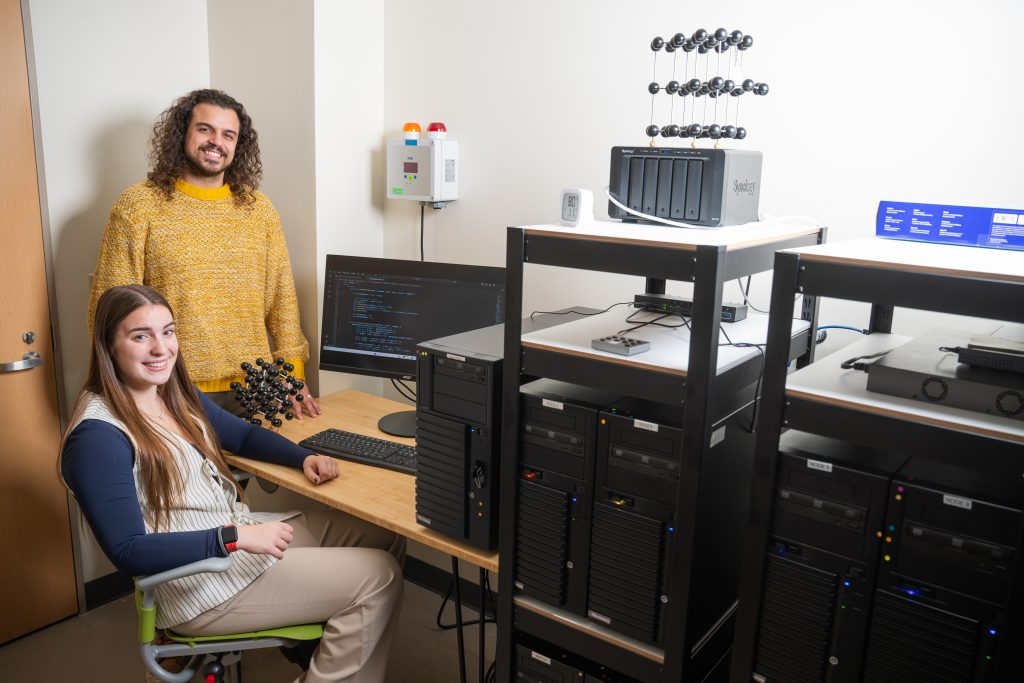
Physics majors Maggie Blanchard and Andre Correa working at the high-performance computing cluster in the QNT

Located at Southern Connecticut State University (SCSU), the QNT will serve as Connecticut’s hub for quantum workforce development. This evolution strengthens the university’s partnership with QuantumCT, a public-private initiative advancing the adoption of quantum technology in Connecticut and beyond. 

SCSU Physics Professor Christine Broadbridge is the founding director for the Center, SCSU executive director of research and innovation, and a member of the QuantumCT leadership team. She has played a key role in the establishment of QuantumCT by leveraging collaborations with Yale University and the University of Connecticut, the state’s two other research universities. The expanded mission of the Center will maximize QuantumCT’s impact on the CSCU system, the private universities, and the surrounding community.    

QuantumCT is also currently a finalist for a National Science Foundation (NSF) grant — “NSF Engine: Advancing Quantum Technologies” — for which Broadbridge is the co-principal investigator. If awarded, the initiative will receive an initial two-year NSF grant of up to $15 million and become eligible for an additional eight years of funding, totaling up to $160 million over 10 years. 

“Quantum technologies will transform Connecticut’s workforce by creating demand for specialized skills and opening lucrative career opportunities in industries such as aerospace, biotech, and finance,” said Broadbridge. “Southern’s strategic location in the second-largest biotechnology hub in New England makes this name change both timely and meaningful. It’s a crucial move that leverages Southern’s ability to adapt quickly and develop an agile workforce, keeping pace with the rapid growth of AI, Quantum and other advanced technologies.” 

The Academic Science and Laboratory Building at Southern Connecticut State University

Originally approved as a CSCU Center of Research Excellence in 2013 and reapproved in 2018, the CNT built a strong foundation in condensed matter physics, materials science, and nanoscale phenomena. Under Broadbridge’s leadership, the center forged partnerships with Yale (through NSF CRISP), UConn’s Institute of Materials Science, Connecticut Community Colleges (now CT State), and regional universities, while also supporting industry via access and training on cutting-edge instrumentation. The expanded Center leverages SCSU’s research strength in astronomy and astrophysics while also building upon its unique programs in engineering and applied physics.

“Our public colleges and universities are not just keeping pace with technological advancements; they are positioning Connecticut to lead it. Southern Connecticut State University is at the forefront of building the state’s quantum workforce. The newly named Center for Quantum and Nanotechnology shows how public higher education drives and democratizes innovation while creating new educational and career pathways to high-demand, high-wage, and family-sustaining careers,” said CSCU Interim Chancellor John Maduko. “The QNT Center reflects our shared commitment to transforming lives through cutting-edge research and advancing Connecticut’s quantum future, made possible by the leadership and vision of Dr. Broadbridge and her team.”

The center’s dual focus on research and experiential learning has transformed hundreds of students’ lives, fostered industry-academic collaborations, and advanced knowledge in multiple fields. Through the Werth Endowed Industry Academic Fellowship (IAF) program, more than 100 fellows have participated, with over 90% now working in STEM fields or pursuing advanced STEM studies. One recent fellow shared: 

“The best part of the fellowship, beyond the research, was the exposure to New Haven’s business and startup ecosystem. It was life-changing to see that my goals are realistic and achievable.” 

While the QNT continues to evolve its programs and expand partnerships to address new scientific and technological challenges, its core commitment remains steadfast: delivering exceptional research, education, training, and outreach services to the state.
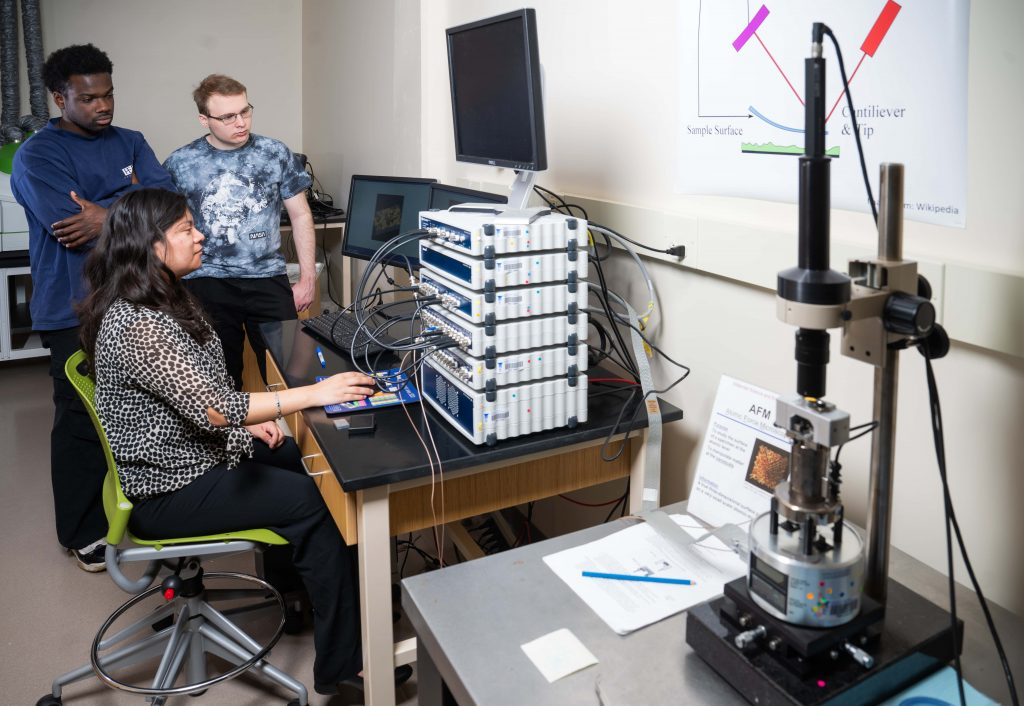
Undergraduate students Crossby Dessalines (computer science), Maritza Sanchez  (chemistry), and Julian Rus (physics) working at the atomic force microscope in the QNT

For more information about the CSCU Center for Quantum and Nanotechnology, visit https://nano.southernct.edu.  

News at Southern | Original Article ↗
Recent News

U.S. National Science Foundation Announces Transformational Award to Connecticut’s Quantum Tech Sector

For Immediate Release
July 14, 2026 —
WASHINGTON, D.C. — The U.S. National Science Foundation (NSF) announced today that
Connecticut is one of twelve regions selected to receive an NSF Regional Innovation
Engines (NSF Engines) award, joining a portfolio of regional technology clusters that are
accelerating the development of critical technologies and building a durable U.S.
technology advantage.
The NSF Quantum Technologies Engine in Connecticut, led by the University of
Connecticut in partnership with Yale University, Southern CT State University, Connecticut
State Community College, ConnCORP, CT Innovations, and the State of Connecticut, aims
to advance American quantum innovation and secure the domestic quantum supply chain
by accelerating the commercialization of quantum technologies for national defense,
biotechnology, and financial services. Through innovation, applied research leading to new
technologies, support for inventors and entrepreneurs, and workforce development, the
NSF Quantum Technologies Engine will advance quantum sensing, secured
communications, computing, and materials through shared testbed, deep-tech incubator
and translation pathways.
“NSF Engines investments in critical technologies and future industries will transform
America’s innovation infrastructure for decades to come,” says Brian Stone, performing the
duties of the NSF director. “The NSF Quantum Technologies Engine will advance the
Nation’s quantum innovation by accelerating the commercialization of quantum
technologies for national defense, biotechnology and financial services.”
The NSF Quantum Technologies Engine in Connecticut (the QuantumCT Engine) team will
initially receive a two-year, $15 million award. The funds will support the Engine’s
technology translation, workforce development, and incubator operations. The funds will
also facilitate industry and community engagement to deliver broad societal benefits. By
demonstrating sufficient progress, the QuantumCT Engine has the potential to receive
$160 million from NSF over the next decade.
The QuantumCT Engine will leverage world-leading research and innovation expertise from
UConn and Yale to pursue translational research to benefit industry, generate technology
ventures, and train the region’s workforce to enter a high-growth field. It will also deliver
technology acceleration and startup support services to drive public-private partnerships
and create a quantum ecosystem that generates economic growth.
Quantum technology industries are expected to grow to $200 billion by 2040, with the
potential to reshape sectors important to Connecticut and the country, including
aerospace, defense, drug development, manufacturing, and finance and insurance.
Connecticut companies that are adopting quantum technologies support over 270,000
jobs, accounting for 38% of wages in the state. They also are responsible for millions of
jobs and over $28.7 billion in GDP nationwide.
“Connecticut is the nation’s leading state for quantum technology adoption,” says Pamir
Alpay, UConn’s provost and the principal investigator on the NSF-funded proposal. “The
award recognizes our team’s success in establishing partnerships with industry to
accelerate quantum technologies and build a quantum-ready workforce.”
“This award application process was highly competitive, and it’s a huge win for
Connecticut,” says Gov. Ned Lamont. “Our pioneering research and advanced application
pipeline helped set us apart from the competition. Whereas other states may be theorizing
about quantum, we’re already applying it together with corporate partners across the state.
These federal funds, combined with state investment, will accelerate Connecticut’s
progress in quantum technology and help establish our state as a national and global
leader in this field—and we’re grateful for NSF’s support in getting us here. This investment
will help create good jobs and new opportunities for workers across the economy as
quantum’s impact grows.”
The NSF Engines program invests in regional ecosystems with the potential to drive
economic growth through technological innovation. The QuantumCT Engine proposal was
chosen for funding from a field of 15 finalists following a highly competitive national
selection process.
“As Connecticut’s flagship public university and the state’s land-grant institution, UConn
takes pride in its leadership role within the QuantumCT Engine. Our university is home to
more than 60 esteemed faculty members who are experts in the field of quantum science
and will collaborate with Yale researchers to drive innovative advancements and
groundbreaking discoveries in quantum research,” UConn President Radenka Maric says.
“Over the past three years, we have been working hand-in-hand with our academic, state,
industry, and community partners to position quantum technologies as a catalyst for
economic development that will fuel prosperity in our state and nation. It is crucial that
America take the lead in the global quantum race to safeguard national security, secure our
digital economy, and drive future economic growth. Furthermore, we must excel
internationally in quantum healthcare to deliver life-saving therapeutics and diagnostics. I
am grateful to Governor Lamont and Dan O’Keefe, the commissioner of the Department of
Economic and Community Development, for their grand vision for our state.”
The State of Connecticut has pledged $121 million to the QuantumCT Engine, comprising
$60 million already invested and an additional $60 million upon receiving the NSF award.
This state support will build a quantum incubator in New Haven, the Engine’s hub, among
other initiatives.
In 2023, NSF awarded the QuantumCT Engine team a $1 million NSF Engines Development
Award through UConn, which established the operational structure and built the
partnerships to drive the ecosystem. QuantumCT, a 501(c)(3) nonprofit organization, was
founded by UConn and Yale as part of the NSF Engine Development Award to support
applied research, help companies explore quantum applications, generate startups, and
prepare a skilled workforce.
Industry partners are key to the QuantumCT Engine’s success. Quantinuum and D-Wave
are partnering to develop quantum computing testbeds with QuantumCT that will be used
for experimentation and technology translation activities.
Quantum technology adopters – including RTX, Travelers, Boehringer Ingelheim, Pfizer,
Amphenol, and Microsoft – have been working with the QuantumCT Engine team over the
past several years on applied research projects that bring quantum capabilities directly to
their product lines.
“With this transformative award, NSF has recognized the scale of the QuantumCT Engine’s
ambition and its potential to accelerate the quantum revolution for our state, region, and
the United States as a whole,” Yale University President Maurie McInnis says.
“I am so proud of this effort to develop real-world solutions that enrich our communities
and of the spirit of collaboration that it represents,” she adds. “Together with our partners at
UConn and across the state, we have been able to drive innovation and unleash economic
growth, while fulfilling Yale’s vital mission of research and education.”
Alongside industry partnerships and state support, sustained investments by UConn and
Yale have helped build the quantum ecosystem that this award will accelerate.
At Yale, this includes startups such as Quantum Circuits, co-founded by Robert Schoelkopf
and Michel Devoret — whose pioneering work in quantum computing earned him the 2025
Nobel Prize in Physics — and recently acquired by tech innovator D-Wave with plans to
double its workforce in New Haven.
Southern Connecticut State University (SCSU) also plays a critical role as the QuantumCT
Engine’s workforce lead, with its QNT (CSCU Center for Quantum and Nanotechnology)
serving as the optimal coordinator based on its successes in leading educational initiatives
and strong alliances with industry, community stakeholders, and IHEs throughout
Connecticut.
Through longstanding technical and education collaborations with Yale, UConn, and the CT
State Community College System, the QNT is a conduit to all academic institutions in the
state and to small and medium businesses including those in advanced manufacturing,
biotech, photonics, and other supply chain sectors.
“Southern Connecticut State University is more than ready to take the lead on workforce
development in Connecticut’s quantum ecosystem,” says Sandra Bulmer, interim
president of the university. “We are proud to be part of Connecticut’s ‘research triangle,’
along with Yale and UConn, serving as the support for the talent pipeline. Our mission is
grounded in access and opportunity, and the workforce piece of this effort enables us to
open up new frontiers in research and innovation to countless students across
Connecticut.”

read more