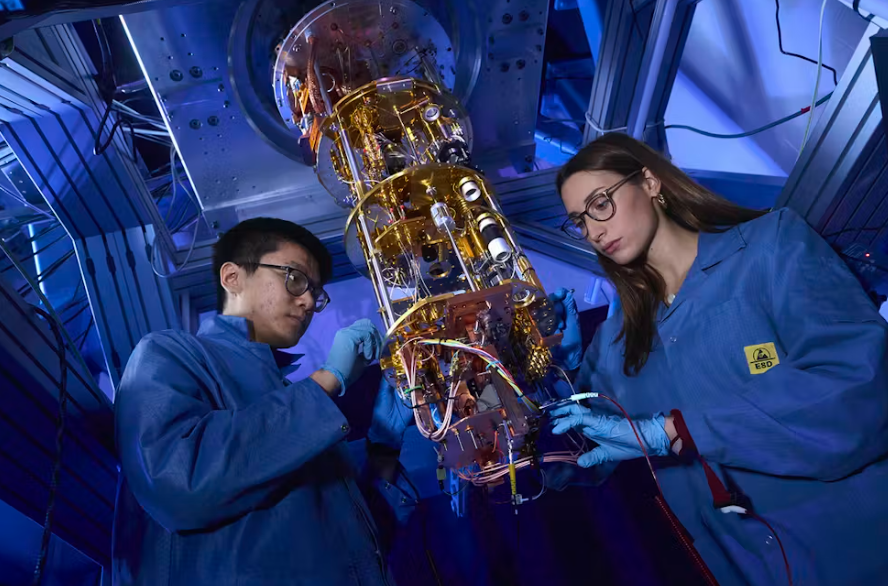
Connecticut’s QuantumCT — a public-private partnership accelerating the adoption of quantum technologies — is developing new quantum models, forging partnerships and strengthening the quantum workforce to improve drug development.
“Currently available classical computer models are inadequate … QuantumCT researchers are working with companies to develop new quantum models and algorithms to make drug development faster, cheaper and safer,” the program’s Co-Principal Investigator and University of Connecticut (UConn) Vice President for Research Innovation and Entrepreneurship Pamir Alpay told GovCIO Media & Research.
QuantumCT is a finalist in the National Science Foundation’s Regional Innovation Engines Program, a federal initiative that funds regions working to turn emerging technologies into practical tools and jobs. The program emphasizes “use-inspired” research that brings together universities, companies and local governments to develop deployable technology solutions.
Building Community Partnerships
Connecticut is home to major industry players in advanced manufacturing, national security and drug development, including Nobel Prize in Physics recipient Michel Devoret, one of the world’s foremost experts in quantum science and technology.
“All the ingredients to drive the development of quantum technologies and their real-world applications are here,” said Alpay. “The most advanced technologies are largely worthless if they are never used to meet societal and economic needs.”
Making Connecticut the “quantum capital of the world,” Alpay said, requires strong foundational relationships across five critical sectors: industry, academia, government, the broader community, and risk capital and entrepreneurship. He added that the engine has made significant progress since launching efforts to build Connecticut’s quantum economy in 2022.
“By building partnerships within our ecosystem, we have six new quantum startups in the state,” said Alpay. “The next step for quantum in Connecticut is the growth of a physical presence in New Haven, with convening spaces, test beds and an accelerator to support innovative ventures.”
Piloting Drug Development Innovations
One academic partnership focused on developing quantum algorithms to help predict the safety of drugs under development.
QuantumCT awarded pilot grants to faculty at Yale University and the UConn to research how quantum-enabled technologies could reduce drug development costs and shorten production timelines. During the award period, companies including Pfizer brought real-world challenge sets to the QuantumCT team.
Faculty teams from both universities then worked with industry partners to identify potential quantum-based solutions. One university research team collaborated with Pfizer to develop quantum algorithms designed to predict drug safety earlier in the development process.
Alpay said the goal of QuantumCT projects is to firmly connect research to real-world applications and address current industry challenges.
“Quantum sounds futuristic, but it’s here right now, and by building partnerships between industry and academia, we can develop new products that help Connecticut’s major industries,” Alpay said. “The real outcomes of these partnerships are innovations that strengthen Connecticut businesses and grow our local economy.”
Expanding QuantumCT’s Footprint
The engine enabled UConn and Yale to collaborate at scale for the first time to address industry-defined challenges. Building on that success, QuantumCT has opened new communication channels among stakeholders to support expanded partnerships and investments, Alpay said.
“Sometimes it’s as simple as getting people into a room and having a conversation,” he said. “Other times, it involves investing research funding into industry challenge problems while ensuring engagement with workforce development and community education.”
Bolstering the Quantum Workforce
Alpay said effective quantum technologies will require a quantum-ready workforce. QuantumCT’s workforce development program aims to grow and sustain the quantum education ecosystem by creating experiential learning opportunities, such as industry apprenticeships, that provide relevant training for entry-level quantum workers.
QuantumCT’s workforce team has worked with industry partners for several years to identify future skill needs and has coordinated with state programs through Connecticut’s Office of Workforce Strategy.
“We are trying to build quantum literacy for those pursuing quantum-adjacent professions, such as business roles,” Alpay said. “We have an outstanding workforce development infrastructure, from kindergarten to retirement, that is ready and capable of training the quantum workforce of the future.”
Silvia Oakland | GovCIO | Original Article ↗