The Upper Science Hill Building Complex will transform Yale’s quantum and engineering programs with new research labs, convening space — and a geothermal plant
Future generations of Yale quantum scientists, engineers, and physicists likely won’t know the details of the monumental effort underway today to reshape the upper slope of Science Hill on campus. But they — and society at large — will reap the benefits.
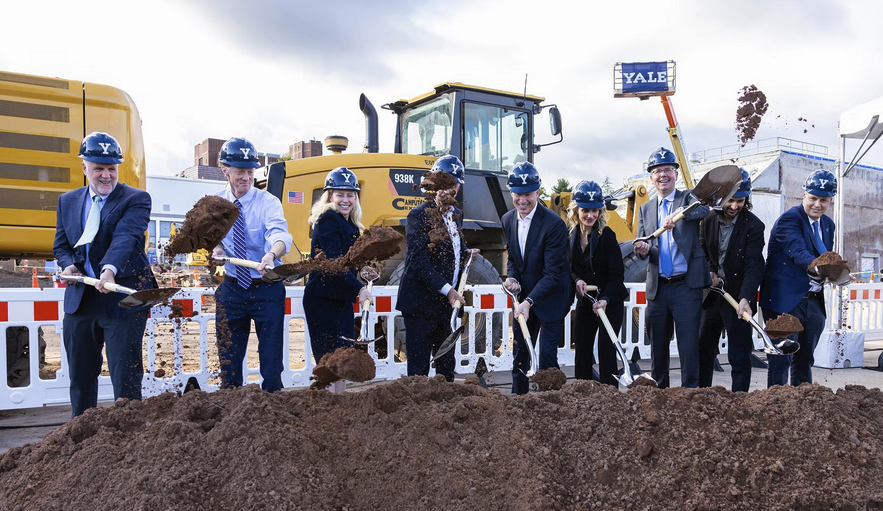
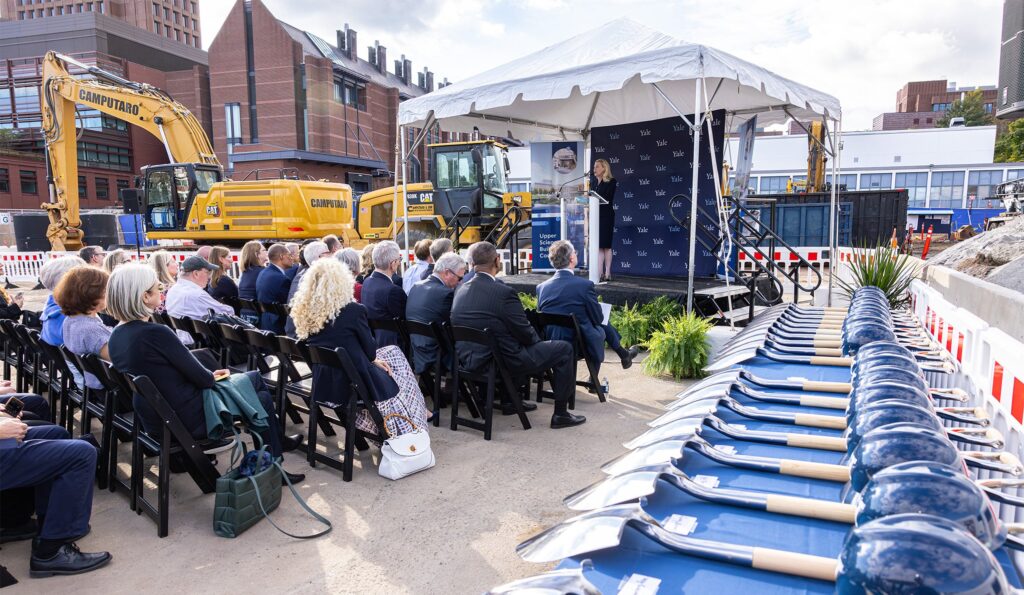
As university leaders and state and local officials gathered Sept. 30 for a ceremonial groundbreaking of the new Physical Sciences and Engineering Building (PSEB) — the centerpiece of the new Upper Science Hill Building Complex — they described a future manifesting in plain sight, with construction cranes and excavators briefly paused just yards away.
“As you can see, all around us, Science Hill is being transformed,” said Yale President Maurie McInnis. “This building we’re breaking ground on today will be the crown jewel of the Upper Science Hill Development. It is fundamental to the work we are doing to accelerate science and engineering at Yale.”
“This building we’re breaking ground on today will be the crown jewel of the Upper Science Hill Development. It is fundamental to the work we are doing to accelerate science and engineering at Yale.”
Yale President Maurie McInnis
The overall project is vast, covering 16 acres — or nearly half — of Science Hill. It will transform research programs, help attract more of the best scientists and students, lower Yale’s energy use, and accelerate discoveries across a range of fields, from quantum computing and materials science to electrical engineering and high energy physics. It may ultimately help grow the state and local economies, as well.
Specifically, it involves building out more than 630,000 square feet of space overall, with nearly 472,000 square feet reserved for research and collaboration. The complex of buildings includes a new Physical Sciences and Engineering Building (PSEB), an Advanced Instrumentation Design Center, a “clean room” located within PSEB for specialized experiments, an addition to Wright Laboratory, core facilities space for materials science and nanoscience research, a new chemical safety building, and a state-of-the-art geothermal energy plant that will heat and cool as many as eight adjacent university buildings.
“We are launching one of the most significant building projects in Yale’s history,” said Provost Scott Strobel, who led the University Science Strategy Committee that in 2018 identified quantum science and related areas of engineering and materials science as a priority — and major opportunity — for Yale.
The new buildings, Strobel said, will not only propel Yale’s leadership in quantum science — which has the potential to translate a knowledge of the complexities of quantum mechanics into a host of new materials, sensors, and devices — but will also offer superior instrumentation and fabrication facilities to researchers in other disciplines, such as astronomy and chemistry.
“Yale must lead the future of science and engineering,” he said. “We must continue to drive innovation and train future leaders in the burgeoning quantum revolution. And we must use our expertise and convening power to help create a robust quantum tech ecosystem for New Haven and Connecticut.”
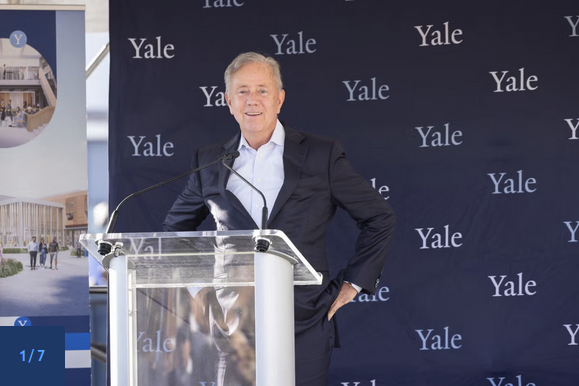
Underscoring the project’s significance for the state and city as well as for Yale, a number of state and local dignitaries, including Connecticut Gov. Ned Lamont, New Haven Mayor Justin Elicker, and University of Connecticut (UConn) President Radenka Marić were on hand for Monday’s groundbreaking ceremony.
It was followed by a reception on the 14th floor of Kline Tower, where the group also celebrated the 10th anniversary of the Yale Quantum Institute.
Lamont noted that the project symbolizes the partnership between Yale, UConn, and the state of Connecticut to create QuantumCT, a regional hub for quantum technology and jobs. He also noted that leaning into quantum research is in keeping with Connecticut’s tradition of innovation going back to the days of Yale graduates Eli Whitney and David Bushnell.
“Connecticut will continue to take the lead,” Lamont said.
Elicker pointed out that the new buildings will not take any existing properties off the city tax rolls. Rather, they have the potential to drive the city’s “innovation economy” and create new jobs.
“It’s just been inspiring,” the mayor said. “We have come a long way, as a city-university partnership.”
Michael Crair, Yale’s vice provost for research, emcee for the ceremony, and a key figure in the development of Science Hill, also highlighted the partnership elements of the project — and the opportunities for collaboration with other research institutions and the private sector.
Site preparation work for the Upper Science Hill Building Complex — which is bordered on three sides by Prospect Street, Edwards Street, and Whitney Avenue — has been ongoing for a year. And planning by the university, with significant input from faculty members, began several years before that.
The overall project includes a host of specialized design features that promote advanced scientific research and sustainability, including the drilling of more than 250 geothermal wells that will, along with a new Thermal Utilities Plant, help heat and cool buildings as part of the university’s plan to achieve zero-carbon status on campus by 2050.
Much of the new research space is being built upon bedrock, which is advantageous for constructing “low-noise” labs — meaning these spaces are less prone to vibrations or other “noise” that might interfere with highly sensitive instruments used in experiments and fabrication processes. About two-thirds of the project’s 50 labs, many located in PSEB, will be low-noise.
“The PSEB complex is like an iceberg,” said Sheri Miller, senior director of sciences campus development for Yale’s Office of Facilities. “Approximately 60% is below ground, creating the most ideal research environment possible. However, in the office, collaboration, and circulation areas the design brings natural light into the space using windows, skylights, and light wells.”
The entire complex will use enough cast-in-place concrete to pave a five-foot-wide sidewalk from New Haven to Providence, Rhode Island.
The first phase of the project technically began at the end of 2023 with the start of construction of a new, 22,000-square-foot chemical safety building on Prospect Street. Construction for that building is set to be finished in 2025. Earlier this year, construction began on the addition to Wright Lab and the Advanced Instrumentation Development Center; the latter will be a university-wide resource built in response to the science priorities identified by the University Science Strategy Committee. Both are scheduled to be completed in 2026.

“The things that will be done here, the science we will do, will be completely new to the universe,” said Sterling Professor of Applied Physics and of physics Robert Schoelkopf, one of Yale’s leading quantum researchers. “Quantum science is so popular right now that we haven’t been able to accommodate all the amazing students who want to come here and be part of it.”
Demolition of the existing chemical safety building and the Pierson Sage Parking Garage is set for next summer and fall, followed by demolition of Wright Lab-West and the Wright Lab electron accelerator lab in 2026.
The second phase of construction will commence with the new thermal plant in 2025 (scheduled for completion in 2028) and the six-floor PSEB complex in 2026 (expected in 2030). A new parking garage, located on Whitney Avenue, will be finished in 2026.
A new, 10,000-square-foot clean room will be incorporated into the PSEB structure. The facility will enable Yale researchers across all disciplines to have access to the latest technologies for nanofabrication.
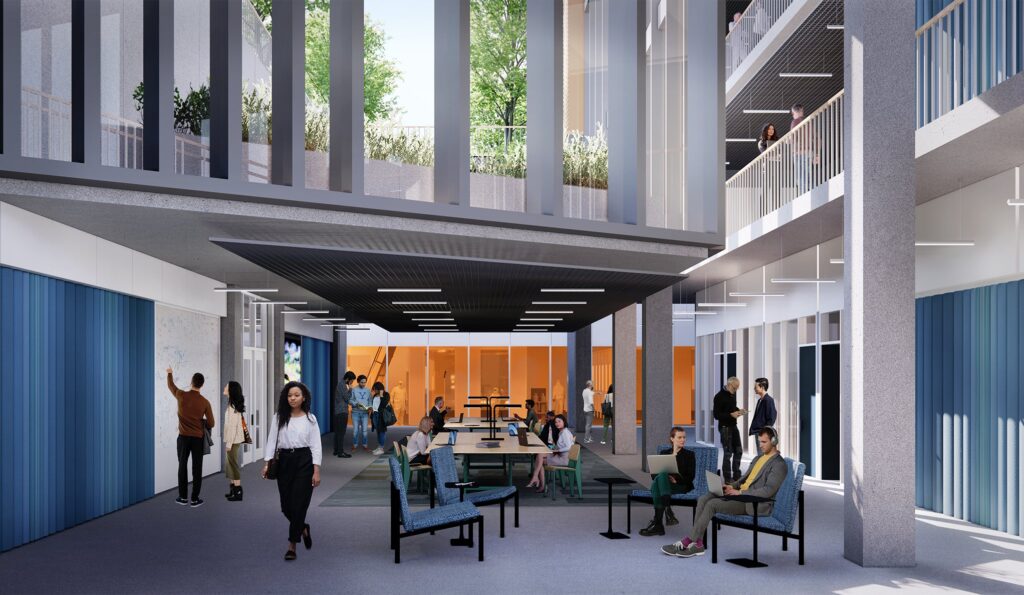
“This will be a transformational project that brings together departments and crosses boundaries,” said Karsten Heeger, the Eugene Higgins Professor and Chair of Physics in Yale’s Faculty of Arts and Sciences (FAS) and faculty co-chair of the project with Sohrab Ismail-Beigi, the Strathcona Professor of Applied Physics and professor of physics and mechanical engineering and materials science at Yale’s School of Engineering & Applied Science.
“It is vitally important to fundamental science in both FAS and Yale Engineering, as we become one of the premiere locations for quantum science and engineering,” Heeger said.
Alongside the cutting-edge science features are innovative sustainability elements, including the field of geothermal boreholes now being drilled at the site.
The holes, each one at least 800 feet deep, are being created with a new, angled drilling technique in which boreholes are drilled both vertically and at angles radiating out from a central “spine” to areas well beneath existing and future structures. Once finished, the Science Hill geothermal grid will connect to nearby buildings and the new thermal utilities plant, providing 14,000 MBH (One MBH equals 1,000 BTUs per hour) of hot water production.
The geothermal network and thermal plant will dramatically advance Yale’s climate action goals and further the efforts of Yale Planetary Solutions (the university-wide initiative created to amplify and drive solutions to the world’s most urgent climate and environmental threats), using electric equipment to circulate water, replacing steam. The system will send heat to the underground borefield during the summer months and pull heat from the ground in winter — lowering total energy use on Science Hill by a projected 20% and reducing central campus emissions by a projected 15%.
Other sustainable aspects of the project include:
- replacing 57,000 gallons of diesel fuel used in the excavation of the Chemical Safety Building site with R-99, a recycled and filtered cooking oil fuel;
- replacing up to 30% of the cement in the concrete mix for PSEB with a ground glass industry byproduct, called pozzolan, reducing carbon emissions in the production of concrete. (Another industry byproduct, slag, will replace half of the Portland cement already poured for the Chemical Safety Building. Both moves reduce the amount of cement that needs to be produced and keep more material out of landfills.); and
- crushing and reusing excavated rock for backfill and landscaping.
PSEB will include a café and a seminar/event pavilion to help build communities of scholarly collaboration; its second floor will have three types of lab configurations and be 100,000 square feet larger than the concourse level of the nearby Yale Science Building, completed in 2019; and the main spine of PSEB will be a “terraced street” that stretches 420 feet.
But the main attractions for the Upper Science Hill Building Complex are all about the future of science — and McInnis, for one, can’t wait to get started.
“I very much believe buildings tell you so much about a community, about what a community values,” she said. “Buildings are an expression, in many ways, of your priorities, your focus, your will to bring a community together to get things done. For us, this building will shine as our commitment to pushing forward the frontiers of knowledge.”
The architectural firm TenBerke, is the design architect, collaborating with Ballinger, the architect and engineer of record for the USHD project. The contractors for the project are Turner Construction Company for phase one and Whiting-Turner Contracting Company for phase two.
Jim Shelton | Yale News | Original Article↗