Researchers Demonstrate Error-Corrected Qudits That Beat Break-Even

Researchers demonstrated quantum error correction for higher-dimensional quantum systems that outperformed uncorrected versions, surpassing the break-even point

In what they’re terming a first for the field, researchers at Yale University have demonstrated quantum error correction for higher-dimensional quantum systems that not only works — but outperforms the best uncorrected alternatives.

The study, published in Nature, reports the successful encoding and protection of quantum information in qutrits and ququarts — quantum units with three and four states, respectively — using a type of error correction known as the Gottesman-Kitaev-Preskill (GKP) bosonic code. Both implementations beat the so-called break-even point, a longstanding benchmark in the field of quantum error correction.

This finding expands the toolbox for building more efficient quantum computers and suggests that future quantum processors may benefit from moving beyond conventional qubits. By proving that multi-level systems can be corrected with fidelity exceeding that of their bare physical implementations, the experiment opens new paths for hardware-lean quantum architectures, fault-tolerant computation, and compact error-protected memories.

The researchers write: “These results rely upon many technical advances, such as our generalization of previous experimental methods and our invention of protocols for measuring qudits in generalized Pauli bases. Our work builds on the promise of hardware efficiency offered by bosonic codes and represents a novel way of leveraging the large Hilbert space of an oscillator. In exchange for a modest reduction in lifetime, we gained access to more logical quantum states in a single physical system. This could enable more efficient compilation of gates and algorithms, alternative techniques for quantum communication and transduction, and advantageous strategies for concatenation into an external multi-qudit code.”

Protecting Fragile Quantum States

Quantum computers are notoriously fragile, the researchers point out. Stray signals, thermal noise and other sources of environmental disturbance can cause quantum bits — or qubits — to lose their information before useful calculations can be completed. To make large-scale machines viable, researchers must find ways to protect quantum states from this degradation, ideally for long enough to execute logical operations.

The concept of the break-even point refers to a threshold at which the effort of encoding and correcting a quantum state results in a net benefit: the corrected state retains its fidelity longer than any uncorrected version. Until recently, this milestone had only been crossed using error-corrected qubits. The new study is the first to do so for error-corrected qudits, which generalize qubits by allowing more than two levels per physical unit.

AI Helps Out

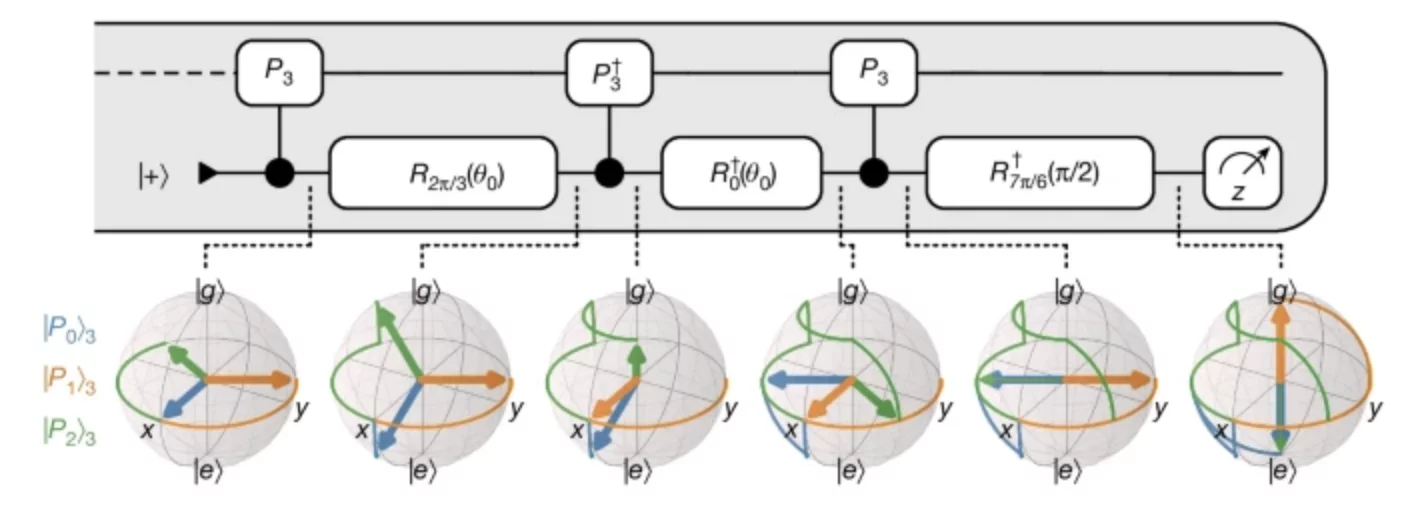
In the experiment, the team used a three-dimensional superconducting microwave cavity to host the quantum oscillator and a tantalum transmon qubit as an ancilla to assist in encoding, stabilizing and reading out the logical states. The logical qutrit and ququart were encoded in special grid-like wavefunctions using the GKP bosonic code, which arranges information in phase space with periodic displacements, making it possible to detect and correct small errors before they become fatal.

To optimize the quantum error correction protocol, the researchers used reinforcement learning, allowing an AI agent to autonomously search for the most effective parameters. The agent adjusted 45 variables in the experimental procedure to maximize the fidelity of the quantum memory across repeated cycles. This model-free optimization strategy permitted fine-tuning that would be impractical using brute-force calibration or analytical modeling alone.

After optimization, the system achieved a quantum error correction gain of 1.82 for the qutrit and 1.87 for the ququart. That means the encoded information lasted about 82% and 87% longer, respectively, than the best comparable uncorrected implementations, which were stored using standard photon number states in the same cavity. The gains are on par with or better than earlier demonstrations of error-corrected qubits using the same device.

QEC Benefits Not Confined to Binary Systems

These results confirm that the benefits of quantum error correction are not confined to binary systems. Using more levels per physical unit can, in principle, encode more information and reduce the number of physical components required for the computation.

When it comes to applications like quantum simulation, quantum chemistry and optimization, this is especially relevant because algorithmic complexity is often a barrier to scale.

Trade-offs And Limitations

Yet, the study also outlines clear trade-offs. As the number of encoded levels increases, the logical states must be placed further apart in phase space and require more energy to maintain, making them more vulnerable to certain kinds of noise. For instance, photon loss and dephasing — types of errors common in superconducting systems — grow with the energy of the state, creating a tension between error-correction capacity and physical durability.

According to the study, the researchers identified the main source of dephasing as the thermal population of the ancilla transmon qubit. In other words, some of the helper qubits (the ancilla qubits) are unintentionally “warm,” and that warmth makes them more likely to be in the wrong state even before the experiment begins.

In future systems, this might be mitigated through improved cooling or the use of actively decoupled ancillary hardware. Other potential improvements include better materials, faster gate speeds, or higher-Q cavities to reduce energy leakage.

Unlike traditional quantum error correction approaches that require many physical qubits to protect one logical qubit, bosonic codes like the GKP protocol offer the possibility of encoding quantum information more compactly. This could simplify hardware requirements and make it easier to scale up quantum processors, especially in platforms where increasing the number of components introduces substantial overhead.

Laying The Groundwork For Future Fault-Tolerant Architectures

The researchers also suggest that their demonstration lays the groundwork for multi-level fault-tolerant architectures, where operations like gate synthesis and magic state distillation — two crucial steps in quantum algorithms — could benefit from the richer structure of qudits. Additionally, GKP-encoded qudits are compatible with existing gate implementations used for qubits, potentially enabling seamless integration with current superconducting systems.

The results build on a growing body of work pushing beyond conventional error correction paradigms. The same Yale device was used in 2023 to demonstrate error correction beyond break-even for qubits. This new experiment extends those results into the multi-level domain and introduces generalized protocols for preparing and measuring GKP qudit states across various bases, an essential step for building logical operations.

Looking ahead, the researchers aim to extend their methods to entangled qudit states, which are required for full-scale computation and more advanced error correction codes. The team also plans to investigate internal concatenation, where a logical qubit is embedded within a logical qudit to create nested layers of protection using a single oscillator.

The research team included: Benjamin L. Brock, Shraddha Singh, Andy Z. Ding, Luigi Frunzio, Steven M. Girvin, all of Yale University; Alec Eickbusch and Volodymyr V. Sivak, both of Google Quantum AI and Michel H. Devoret, joint affiliation at UC Santa Barbara and Google Quantum AI.

The study was supported by the U.S. Department of Energy, the Army Research Office, and the Air Force Office of Scientific Research, reflecting growing government interest in foundational technologies that could underpin future quantum platforms.

Matt Swayne | Quantum Insider | Original Article↗
Recent News

U.S. National Science Foundation Announces Transformational Award to Connecticut’s Quantum Tech Sector

For Immediate Release
July 14, 2026 —
WASHINGTON, D.C. — The U.S. National Science Foundation (NSF) announced today that
Connecticut is one of twelve regions selected to receive an NSF Regional Innovation
Engines (NSF Engines) award, joining a portfolio of regional technology clusters that are
accelerating the development of critical technologies and building a durable U.S.
technology advantage.
The NSF Quantum Technologies Engine in Connecticut, led by the University of
Connecticut in partnership with Yale University, Southern CT State University, Connecticut
State Community College, ConnCORP, CT Innovations, and the State of Connecticut, aims
to advance American quantum innovation and secure the domestic quantum supply chain
by accelerating the commercialization of quantum technologies for national defense,
biotechnology, and financial services. Through innovation, applied research leading to new
technologies, support for inventors and entrepreneurs, and workforce development, the
NSF Quantum Technologies Engine will advance quantum sensing, secured
communications, computing, and materials through shared testbed, deep-tech incubator
and translation pathways.
“NSF Engines investments in critical technologies and future industries will transform
America’s innovation infrastructure for decades to come,” says Brian Stone, performing the
duties of the NSF director. “The NSF Quantum Technologies Engine will advance the
Nation’s quantum innovation by accelerating the commercialization of quantum
technologies for national defense, biotechnology and financial services.”
The NSF Quantum Technologies Engine in Connecticut (the QuantumCT Engine) team will
initially receive a two-year, $15 million award. The funds will support the Engine’s
technology translation, workforce development, and incubator operations. The funds will
also facilitate industry and community engagement to deliver broad societal benefits. By
demonstrating sufficient progress, the QuantumCT Engine has the potential to receive
$160 million from NSF over the next decade.
The QuantumCT Engine will leverage world-leading research and innovation expertise from
UConn and Yale to pursue translational research to benefit industry, generate technology
ventures, and train the region’s workforce to enter a high-growth field. It will also deliver
technology acceleration and startup support services to drive public-private partnerships
and create a quantum ecosystem that generates economic growth.
Quantum technology industries are expected to grow to $200 billion by 2040, with the
potential to reshape sectors important to Connecticut and the country, including
aerospace, defense, drug development, manufacturing, and finance and insurance.
Connecticut companies that are adopting quantum technologies support over 270,000
jobs, accounting for 38% of wages in the state. They also are responsible for millions of
jobs and over $28.7 billion in GDP nationwide.
“Connecticut is the nation’s leading state for quantum technology adoption,” says Pamir
Alpay, UConn’s provost and the principal investigator on the NSF-funded proposal. “The
award recognizes our team’s success in establishing partnerships with industry to
accelerate quantum technologies and build a quantum-ready workforce.”
“This award application process was highly competitive, and it’s a huge win for
Connecticut,” says Gov. Ned Lamont. “Our pioneering research and advanced application
pipeline helped set us apart from the competition. Whereas other states may be theorizing
about quantum, we’re already applying it together with corporate partners across the state.
These federal funds, combined with state investment, will accelerate Connecticut’s
progress in quantum technology and help establish our state as a national and global
leader in this field—and we’re grateful for NSF’s support in getting us here. This investment
will help create good jobs and new opportunities for workers across the economy as
quantum’s impact grows.”
The NSF Engines program invests in regional ecosystems with the potential to drive
economic growth through technological innovation. The QuantumCT Engine proposal was
chosen for funding from a field of 15 finalists following a highly competitive national
selection process.
“As Connecticut’s flagship public university and the state’s land-grant institution, UConn
takes pride in its leadership role within the QuantumCT Engine. Our university is home to
more than 60 esteemed faculty members who are experts in the field of quantum science
and will collaborate with Yale researchers to drive innovative advancements and
groundbreaking discoveries in quantum research,” UConn President Radenka Maric says.
“Over the past three years, we have been working hand-in-hand with our academic, state,
industry, and community partners to position quantum technologies as a catalyst for
economic development that will fuel prosperity in our state and nation. It is crucial that
America take the lead in the global quantum race to safeguard national security, secure our
digital economy, and drive future economic growth. Furthermore, we must excel
internationally in quantum healthcare to deliver life-saving therapeutics and diagnostics. I
am grateful to Governor Lamont and Dan O’Keefe, the commissioner of the Department of
Economic and Community Development, for their grand vision for our state.”
The State of Connecticut has pledged $121 million to the QuantumCT Engine, comprising
$60 million already invested and an additional $60 million upon receiving the NSF award.
This state support will build a quantum incubator in New Haven, the Engine’s hub, among
other initiatives.
In 2023, NSF awarded the QuantumCT Engine team a $1 million NSF Engines Development
Award through UConn, which established the operational structure and built the
partnerships to drive the ecosystem. QuantumCT, a 501(c)(3) nonprofit organization, was
founded by UConn and Yale as part of the NSF Engine Development Award to support
applied research, help companies explore quantum applications, generate startups, and
prepare a skilled workforce.
Industry partners are key to the QuantumCT Engine’s success. Quantinuum and D-Wave
are partnering to develop quantum computing testbeds with QuantumCT that will be used
for experimentation and technology translation activities.
Quantum technology adopters – including RTX, Travelers, Boehringer Ingelheim, Pfizer,
Amphenol, and Microsoft – have been working with the QuantumCT Engine team over the
past several years on applied research projects that bring quantum capabilities directly to
their product lines.
“With this transformative award, NSF has recognized the scale of the QuantumCT Engine’s
ambition and its potential to accelerate the quantum revolution for our state, region, and
the United States as a whole,” Yale University President Maurie McInnis says.
“I am so proud of this effort to develop real-world solutions that enrich our communities
and of the spirit of collaboration that it represents,” she adds. “Together with our partners at
UConn and across the state, we have been able to drive innovation and unleash economic
growth, while fulfilling Yale’s vital mission of research and education.”
Alongside industry partnerships and state support, sustained investments by UConn and
Yale have helped build the quantum ecosystem that this award will accelerate.
At Yale, this includes startups such as Quantum Circuits, co-founded by Robert Schoelkopf
and Michel Devoret — whose pioneering work in quantum computing earned him the 2025
Nobel Prize in Physics — and recently acquired by tech innovator D-Wave with plans to
double its workforce in New Haven.
Southern Connecticut State University (SCSU) also plays a critical role as the QuantumCT
Engine’s workforce lead, with its QNT (CSCU Center for Quantum and Nanotechnology)
serving as the optimal coordinator based on its successes in leading educational initiatives
and strong alliances with industry, community stakeholders, and IHEs throughout
Connecticut.
Through longstanding technical and education collaborations with Yale, UConn, and the CT
State Community College System, the QNT is a conduit to all academic institutions in the
state and to small and medium businesses including those in advanced manufacturing,
biotech, photonics, and other supply chain sectors.
“Southern Connecticut State University is more than ready to take the lead on workforce
development in Connecticut’s quantum ecosystem,” says Sandra Bulmer, interim
president of the university. “We are proud to be part of Connecticut’s ‘research triangle,’
along with Yale and UConn, serving as the support for the talent pipeline. Our mission is
grounded in access and opportunity, and the workforce piece of this effort enables us to
open up new frontiers in research and innovation to countless students across
Connecticut.”

read more